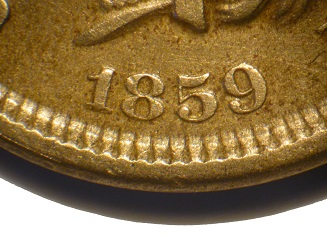
Obverse 12 is observed with date placement at RH and has developed
moderately heavy die flow lines by the denticles.
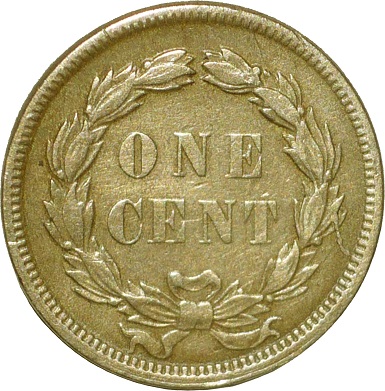
Reverse K was struck from misaligned working dies and is in a similar
die state as obverse 12, with the presence of moderately heavy die flow
lines by the denticles. Reverse K develops the following die
cracks:
1. Die crack from the rim at 12:30 downward through the right
wreath to the denticles at 4:00.
2. Die crack from the rim at 7:15 up through the wreath to
the denticles at 10:15.
3. Die crack from the rim at 8:15 connects with the
die crack from #2.
Comments: David
Killough contacted this author during early June 2016 to request
attribution of an 1859 cent with reverse die cracking that he
identified. Upon examination of the coin, I decided to list
the coin based on the severity of the die cracking at 4:00.
To be candid, some extrapolation of die crack progession was
necessary at 1:30 and 9:30 due to the grade. However, the
reverse K die crack mapping is an accurate assessment of the die state.
The variety 10 die pairing presents an interesting contrast between
obverse 12 and reverse K, where reverse K has sustained multiple die
cracking and obverse 12 has escaped with no cracking.