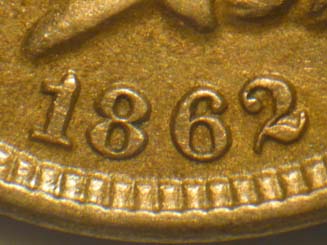
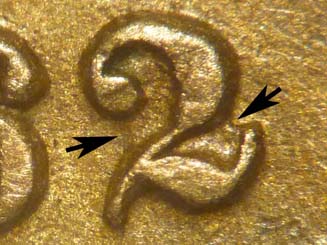
Obverse 43 is observed with date placement at LH and raised area under
the 2 of the date. Obverse 43 has developed moderately heavy
die flow lines.
Reverse AQ is in a similar die state as Obverse 43, with the
advancement of moderately heavy die flow lines. Reverse AQ
has developed the following die cracks:
1. Die crack from the rim at 1:00 downward through the right
wreath to the rim at 2:15. A lighter die crack splits from
this die crack at 1:30 within the wreath and continues diagonally
upward into the upper right side of the shield.
2. Die crack from the rim at 4:00 upward through the right
wreath to 2:15, where it splits and rejoins to connect with die crack
#1.
3. Die crack from the rim at 8:00 through the olive leaves
and through the ribbon knot.
4. Section of die crack from the middle olive leaf upward
through the left wreath.
5. Die crack from the rim at 9:45 upward through the left
wreath.
6. Die crack from the rim at 11:30 into the top left of the
shield.
Comments:
The Reverse AQ die cracking is more severe between 1:00 and
4:00, with the remaining die cracking light in comparison.
The raised area under the 2 of the date is a product of the digit punch
that was utilized to impress the date into Obverse 43 and appears on
many 1862 obverses.
Variety 41 was first identified by David Killough, who submitted the
above plate coin during late August 2019 for inclusion in this book
based on the Obverse 43 digit punch artifact and the die cracking of
Reverse AQ.
Plate Coin:
Courtesy of David Killough Collection, XF40