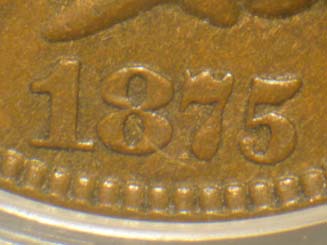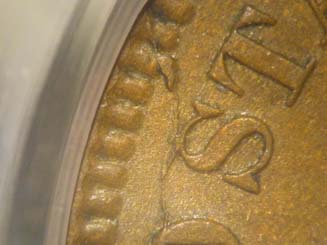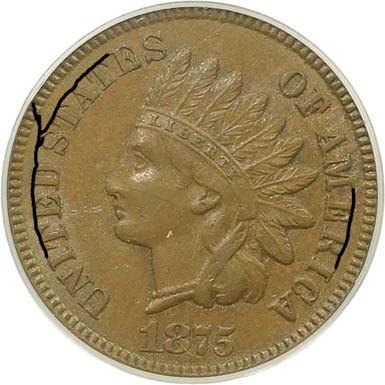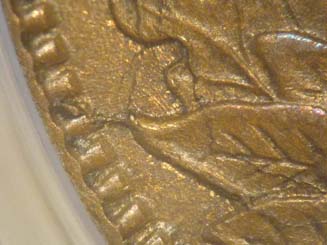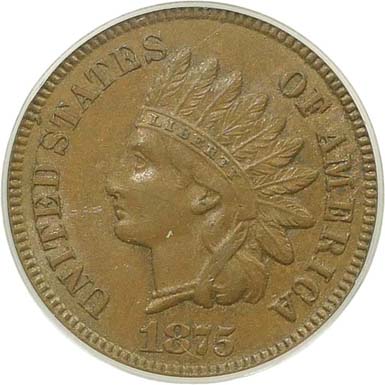
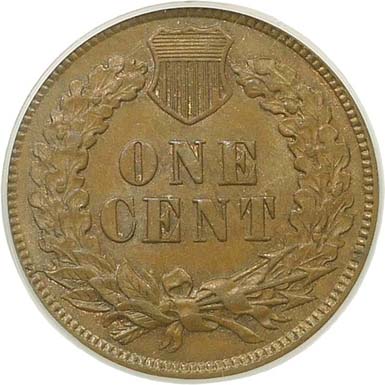
Obverse 27 is observed with date placement at B. Obverse 27
develops the following die cracks:
1. Light die crack connecting A(MERI)CA.
2. Heavy die crack from the denticles at 10:00 downward
connecting the tops of UN(ITED).
3. Light die crack splits from die crack #2 above (S)TATES
and connects the tops of (STATE)S.
Reverse Y is observed with a die chip located at the upper left section
of the O(N)E. Reverse Y has acquired a clash mark through
(C)ENT and develops the following die cracks:
1. Light die crack from the denticles at 2:30 upward through
the outer edge of the right wreath.
2. Die crack from the denticles at 3:15 downward through the
middle and lower arrowheads.
3. Die crack from the wreath stem and through the right
ribbon end.
4. Light die crack from the denticles at 5:30 upward into the
wreath stem.
5.. Die crack from the rim at 6:45 into the arrow quill.
6. Heavy die crack from the rim at 8:00 downward through the
olive leaves and into the knot.
7. Die crack from the rim at 9:45 downward through the left
wreath where it splits and intersects die crack #6.
8. Die crack from the rim at 12:00 into the upper left of the
shield and through the outer edge of the left wreath.
Comments:
The Reverse Y die chip located at the upper left section of
O(N)E is purported to be a mark made onto the reverse die by the Mint
in order to catch a reported Mint employee pilfering newly minted
cents. The idea of marking the reverse die would prove
without a doubt if the suspected employee was indeed pilfering mint
product if he was found with the reverse marked cents on his person.
The following letter written by A. Loudon Snowden to James
Pollock , which was first published in May, 1972 by R.W. Julian in Numismatic Scrapbook magazine
in an article called “The
Case of the Disappearing Cent”, outlines how a Mint
employee was caught pilfering cents from the Mint:
Mint of the United States
Coiner’s Department
Philadelphia
August 24, 1875
The Honorable James Pollock, Sup’t.
Sir:
Having reported
to you my suspicions as to the honesty of X [the name is left out of
letter because. & will be seen below, the man was not really a
hardened criminal] employed in the coining room of this department and
having received from you before your departure into the country
authority to suspend him in case my suspicions were confirmed or
strengthened I have the honor to submit the following facts in relation
to the further development of the case.
On the morning
after our conference I was satisfied from the evidence presented to me
that X had taken some of the one cent coins and had them on his person.
But being anxious to fix his guilt clearly beyond any cavil or doubt, I
instructed him not to use more than one coining press so that X’s
actions could be the more closely watched and that he should report to
me any suspicious actions on X’s part About 11 a.m. Mr. Downing
reported that X had been acting in a suspicious manner and that in his
judgment he had some of the marked coin on his person. In your absence
I sent for Mr. Hickox, acting superintendent, and informed him of all
the facts, and requested him to remain with me whilst I sent for and
examined Mr. X, which he did.
I sent for X,
and after closing the door to prevent our being disturbed I told him
that some of the employees suspected him of taking coin out of the
coining room. He was little agitated, but laughingly told me that it
was a great mistake. I then asked him whether he had any coin on his
person and he said be had some, which had been given him by his son. I
told him that any coin given him by his son could be designated as the
coin of today had been struck upon a marked die.
At this he
immediately became very distressed and wanted a private interview. I
went with him into the vault connected with my room and he in there
confessed that he had recently taken a few cents and begged me to
overlook the offense. I told him how much distressed I was to see that
an old man of his long connection with the Mint detected al such an
offense. I sincerely sympathized with his family and himself, but I
could not overlook an offense which was known to several of the
employees as well as to you, the superintendent.
I then took him
back to the presence of Mr. Hickox, where he again confessed his guilt.
I then exhibited to Mr. Hickox two (2) pieces from the marked dies
given to me by Mr. Downing and asked X to take out of his pocket the
coin he had pilfered. After some trouble he was made to empty his
pockets and we found upon him thirty-three (33) cents marked in a
similar manner to the ones previously in my possession. These pieces
were sealed up in our own presence together with the proper endorsement
Mr. Downing was requested to put up another lot from the same press in
an envelope and seal the same which he did. These packages are now in
my vault and subject to your examination. I immediately suspended him.
Mr. X tendered
his resignation for such action as you may see fit. Mr. X has been
connected with this institution almost continuously for over 50 years.
He is now a very old man, being upwards of 76 years of age. Of late he
has manifested in many ways the weakness of his mind and I think it
charitable to say that his grave fault can be attributed to mental
decay and weakness more than any other cause.
The
feeblemindedness has manifested itself in a marked manner since his
recent detection and peculations. At one moment he appears in the very
depths of despair and humiliation demeaning himself for the crime. With
the very next he speaks of himself as the poor victim of uncharitable
people.
I felt it in my
duty to present the whole facts for such action as you may deem proper.
I will add that from present appearances I do not think X will long
survive this terrible blow. His mental suffering I will not attempt to
describe. One cannot witness it unmoved.
I am, very respectfully
(signed) A. Loudon Snowden,
Coiner