DEFINITIVE REFERENCE FOR INDIAN CENT DIE VARIETIES


Home
Table of Contents
For Sale List
Numismatic Links
David's Numismatic Blog

1899 Variety 5


Obverse 5.2

Reverse D.2


Obverse Diagnostics


Date Position

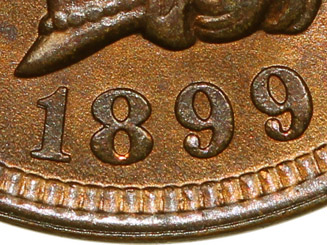
Repunched 1 and 8 (Click Image To Enlarge)

Artifact In The Denticles (Click Image To Enlarge)


Die Lines (Click Image To Enlarge)

Die Lines (Click Image To Enlarge)


Reverse Diagnostics


Reverse D.2 Die Crack Mapping


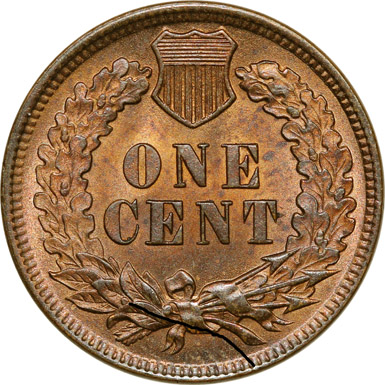
Rev. D.2 Die Crack (Click Image To Enlarge)


The second usage of Obverse 5.  Obverse 5 is identified by date placement at B, an artifact within the denticles below the first 9 and date repunching that features initial date impressions to the south below the flag of the 1, as well as within the upper loop and under the left side of the upper loop of the 8.  Obverse 5 is observed with die lines below 'LIB(ERT)Y' , with some die lines extending through the headband and die lines through the hair curl located below the ear.

The second usage of Reverse D.  Reverse D is rotated 5 degrees clockwise and has developed the following die crack:
1.  Die crack from the rim at 5:15 extends upward through the base of the ribbon knot and continues through the olive leaves.

Comments:  Variety 5 represents the second usage of Obverse 5 and Reverse D, both of which were previously striking proof cents during the 1899 Proof 6 Die Pairing.

Plate Coin:  Courtesy of David Killough Collection, MS64RB

Return to 1899 Varieties Table

Return to Date and Die Variety Analysis