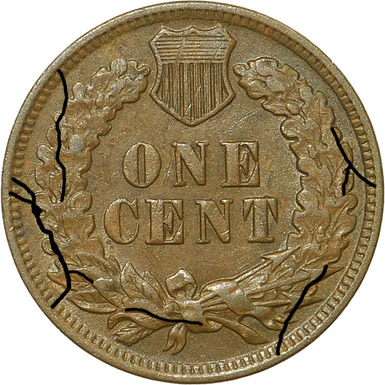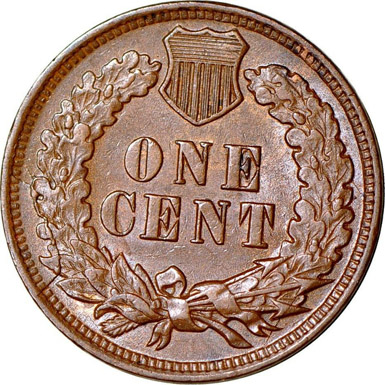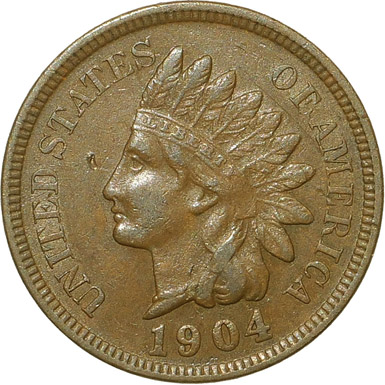
Reverse AF is rotated 5 degrees clockwise. Reverse AF has
acquired a clash mark through (C)ENT and has developed the following
die cracks:
1. Die crack from the rim at 3:00 upward through the rigtht
wreath.
2.
Die crack segment extends downward from die crack #1 near the
acorn at 3:00. This die crack is most likely associated with
die
crack #3.
3. Die crack from the rim at 5:00 upward through the right
ribbon end, lower and middle arrowheads.
4.
Die crack segment extending from the olive leaf above the
arrow
quill into the ribbon knot. This die crack is most likely
associated with die crack #5.
5. Die crack segment extends from die crack #6 at the upper
olive leaf downward.
6.
Heavy die crack from the rim at 7:45 upward through the outer
edge of the left wreath, where it splits and enters the rim at 9:00 and
9:15.
7. Die crack from the rim at 10:30 downward through the left
wreath. Rev. AF.2:
The die cracking between 7:45 and 9:00 has become more
severe, with a bi-level field area developing at 7:45.
Comments: Variety
31 was
first identified by David Killough, who submitted the above plate coin
during mid May 2020 for inclusion in this book based on the die
cracking of Reverse AF.
During the Reverse AF.2 Die State, the die cracking between 7:45 and
9:00 has become more severe, with a bi-level field area developing at
7:45. The section between 7:45 and 9:00 will eventually
separate from the die body and form a retained cud during a subsequent
Reverse AF die state. The Reverse AF die state with the
formation of a retained cud was first illustrated in the 'The Cud Book' by
Sam Thurman and Arnold Margolis, with a reference number of 1C-04-1R
RET.
Plate Coin (Variety 31):
Courtesy of David Killough Collection, AU50
Plate Coin (Variety 31a):
Images courtesy of Rick Snow