DEFINITIVE
REFERENCE FOR INDIAN CENT DIE VARIETIES
Home
Table of Contents
For Sale List
Numismatic Links
David's Numismatic Blog
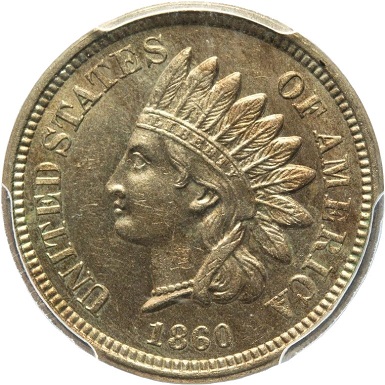
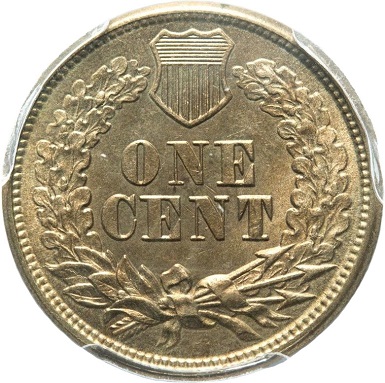
1860 Type 1
Variety 2
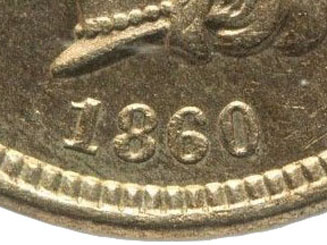
Obverse 2 is observed
with date placement at RH.
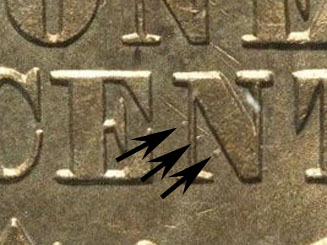
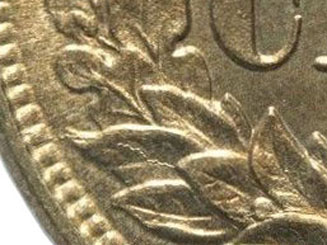
Reverse E is identified by three clash marks from another working die
located on either side of the left leg of N of CENT. Reverse
E develops the following die crack:
1. Die crack from the rim at 8:00 into the left wreath.
Comments:
Three clash marks from the denticles of another die are
evident
on either side of the left leg of the N in CENT. Clash marks
are
caused by two dies striking each other with no planchet between, thus
imparting images onto each die. Most clashed dies that occur
show
reverse images on the obverse and obverse images on the reverse and
these images are usually upside down because of coin orientation,
unless there was a die rotation evident during production.
This
reverse shows misaligned clash marks that were not imparted
from
secured dies from the coining press as described above. There
is
only speculation as to how these occured. One theory is that
the
hammer die, which is the obverse die for indian cents, fell out and
struck the anvil die, which is the reverse die. However,
there
are obverse dies that exhibit this misaligned clashed die anomaly, so
that theory seems to be untenable. Another theory is
that it was a "hardness" test during the hubbing of working dies.
Working dies would be annealed between hubbings so that they
could accept the image from the working hub. The
speculation is that an awl, digit punch (usually used in inconspicuous
areas such as the denticles or within the design) or, in this instance
another die, would be
used against the working die in its annealed state to ascertain if it
was workable enough to accept a good image from the working hub.
This theory seem to work, since the 1880 Snow 1 exhibits this
type of die clashing and
the clashing is evident in recessed areas of the die, namely the E of
ONE on the reverse. This could not have happend when the dies
were hardened, but rather when they were soft from annealing.
In
this instance, it would be logical to assume that the clashes occured
during the hubbing process as a "hardness" test. As for
misaligned clashed dies that appear through the denomination but not in
the recessed areas of the die, I would conclude that the working die
was not as soft as the 1880 Snow 1 example was.
During early February 2016, Richard Ashton contacted this author with permission to use his images to illustrate variety 2 for this book, since I had no plate coin.
Plate Coin:
Richard Ashton, PCGS MS63