DEFINITIVE REFERENCE FOR INDIAN CENT DIE VARIETIES


Home
Table of Contents
For Sale List
Numismatic Links
David's Numismatic Blog

1882 Variety 7


Obverse 10

Reverse I


Obverse Diagnostics


Date Position

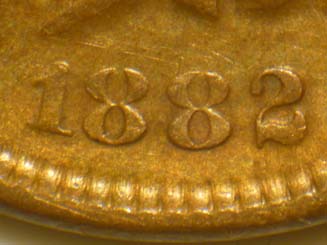
Broken Top 1st 8 and Partially Broken Top 2nd 8

Die Flow Lines


Reverse Diagnostics


Reverse I Die Crack Mapping
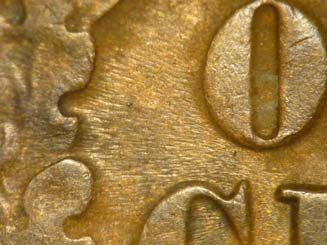

Die Flow Lines


Obverse 10 is observed with date placement at LE and broken top of the first 8 and partially broken top of the second 8.  Obverse 9 has developed heavy die flow lines.

Reverse I is in a similar die state as obverse 10, with the advancement of heavy die flow lines.  Reverse I has developed the following die crack:
1.  Die crack within the right wreath at 2:00 that extends downward along the outer edge of the wreath through the middle and lower arrowheads.

Comments:  Obverse 10 has utilized the same broken digit punch as used on Obverse 9 from the Variety 6 Die Pairing.  However, the digit punch has degraded further with a complete breakage above the first 8 on Obverse 10.

Obverse 9 and Obverse 10 are very similar with both positioning and appearance of the date being differentiating factors.  The date appearance of Obverse 10 exhibits more open loops of the 8 digits, greater distance between digits and slightly smaller digits in comparison to the date of Obverse 9.  The most visible difference between both obverses is the size of the base of the 2 digit.  These attributes of Obverse 10 may be the result of digit punch impression depth and/or die lappng or polishing of Obverse 10.


Obverse 9 Date

Obverse 10 Date

Variety 7 was first identified by David Killough, who submitted the above plate coin during late July 2017 for inclusion in this book based on the broken and partially broken tops of the 8 digits of Obverse 10.

Plate Coin:  David Killough Collection, XF40

Return to 1882 Varieties Table

Return to Date and Die Variety Analysis